Algorithmic learning in a random world
Springer, 2005 (first edition), 2022 (second edition)
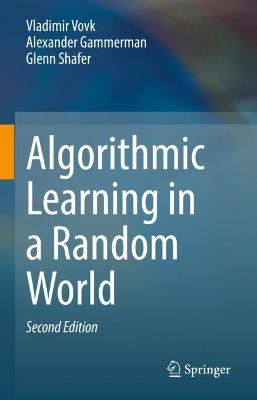 The main topic of this book is conformal prediction,
a method of prediction recently developed in machine learning.
Conformal predictors are among the most accurate methods of machine learning,
and unlike other state-of-the-art methods,
they provide information about their own accuracy and reliability.
The main topic of this book is conformal prediction,
a method of prediction recently developed in machine learning.
Conformal predictors are among the most accurate methods of machine learning,
and unlike other state-of-the-art methods,
they provide information about their own accuracy and reliability.
The book integrates mathematical theory and revealing experimental work.
It demonstrates mathematically the validity of the reliability claimed by conformal predictors
when they are applied to independent and identically distributed data,
and it confirms experimentally that the accuracy is sufficient for many practical problems.
Later chapters generalize these results to models called repetitive structures,
which originate in the algorithmic theory of randomness and statistical physics.
The approach is flexible enough to incorporate most existing methods of machine learning,
including newer methods such as boosting and support vector machines
and older methods such as nearest neighbours and the bootstrap.
Topics and Features:
- Describes how conformal predictors yield accurate and reliable predictions,
complemented with quantitative measures of their accuracy and reliability
- Handles both classification and regression problems
- Explains how to apply the new algorithms to real-world data sets
- Demonstrates the infeasibility of some standard prediction tasks
- Explains connections with Kolmogorov's algorithmic randomness,
recent work in machine learning, and older work in statistics
- Develops new methods of probability forecasting
and shows how to use them for prediction in causal networks
Researchers in computer science, statistics, and artificial intelligence
will find the book an authoritative and rigorous treatment
of some of the most promising new developments in machine learning.
Practitioners and students in all areas of research
that use quantitative prediction or machine learning
will learn about important new methods.
The book may be purchased directly from Springer
and from many on-line booksellers,
including amazon.com.
Vladimir Vovk and Alex Gammerman
are Professors of Computer Science at Royal Holloway, University of London.
Glenn Shafer is Professor
in the Rutgers School of Business - Newark and New Brunswick.
All three authors are affiliated with the
Centre
for Reliable Machine Learning
at Royal Holloway, University of London.
Errata etc.
- For our current list of errata, complements, and comments
click here.
- If you see other errors or have suggestions for improvement,
please e-mail the authors.
This section links to the authors' papers that develop and review the theory presented in the book.
They are often also published on arXiv,
in conference proceedings, or in journals,
but the version given in this section is usually most up-to-date.
The name of this project derives from the title of Part IV of the second edition
and refers to a new kind of modelling uncertainty
going back to Kolmogorov's complexity modelling.
The most standard online compression model is the exchangeability model,
and many of the papers in this project assume exchangeability.
The following working papers develop the ideas presented in the first edition:
- Working Paper 1.
"On-line predictive linear regression"
by Vladimir Vovk, Ilia Nouretdinov and Alex Gammerman.
This article is written for statisticians.
We consider the on-line predictive version
of the standard statistical problem of linear regression;
the goal is to predict each consecutive response
given the corresponding explanatory variables
and all the previous observations.
We are mainly interested in prediction intervals rather than point predictions.
The standard treatment of prediction intervals in linear regression analysis
has two drawbacks:
(1) the usual prediction intervals
guarantee that the probability of error
is equal to the nominal significance level epsilon,
but this property per se does not imply that the long-run frequency of error
is close to epsilon;
(2) it is not suitable for prediction of complex systems
as it assumes that the number of observations
exceeds the number of parameters.
We state the book's result
showing that in the on-line protocol
the frequency of error does equal the nominal significance level,
up to statistical fluctuations,
and we describe alternative regression models
in which informative prediction intervals can be found
before the number of observations exceeds the number of parameters.
One of these models,
which only assumes that the observations are independent and identically distributed,
is greatly underused in the statistical theory of regression.
Published in the Annals of Statistics
37:1566–1590 (2009).
- Working Paper 2.
"Hedging predictions in machine learning"
by Alex Gammerman and Vladimir Vovk.
This is a written version of the second Computer Journal lecture,
presented at the British Computer Society London Office on 12 June 2006.
The lecture was followed by a discussion
by some of the leading experts in machine learning,
which is also included in the article.
Its definitive version is
published
in the Computer Journal 50:151–177 (2007).
This is the description of conformal prediction as given in the article's abstract:
Recent advances in machine learning make it possible
to design efficient prediction algorithms for data sets with huge numbers of parameters.
This article describes a new technique for "hedging" the predictions
output by many such algorithms,
including support vector machines, kernel ridge regression, kernel nearest neighbours,
and by many other state-of-the-art methods.
The hedged predictions for the labels of new objects
include quantitative measures of their own accuracy and reliability.
These measures are provably valid under the assumption of randomness,
traditional in machine learning:
the objects and their labels are assumed to be generated independently
from the same probability distribution.
In particular, it becomes possible to control (up to statistical fluctuations)
the number of erroneous predictions by selecting a suitable confidence level.
Validity being achieved automatically,
the remaining goal of hedged prediction is efficiency:
taking full account of the new objects' features
and other available information to produce as accurate predictions as possible.
This can be done successfully using the powerful machinery of modern machine learning.
- Working Paper 3.
"A tutorial on conformal prediction"
by Glenn Shafer and Vladimir Vovk.
This tutorial presents a self-contained account
of the theory of conformal prediction and works through several numerical examples.
Published
in the Journal of Machine Learning Research
9:371–421 (2008).
- Working Paper 4.
"Plug-in martingales for testing exchangeability on-line"
by Valentina Fedorova, Alex Gammerman, Ilia Nouretdinov, and Vladimir Vovk.
A standard assumption in machine learning is the exchangeability of data,
which is equivalent to assuming that the examples are generated
from the same probability distribution independently.
This paper is devoted to testing the assumption of exchangeability on-line:
the examples arrive one by one,
and after receiving each example we would like to have a valid measure of the degree
to which the assumption of exchangeability has been falsified.
Such measures are provided by exchangeability martingales.
We extend known techniques for constructing exchangeability martingales
and show that our new method is competitive with the martingales introduced before.
Finally we investigate the performance of our testing method on two benchmark datasets,
USPS and Statlog Satellite data;
for the former, the known techniques give satisfactory results,
but for the latter our new more flexible method becomes necessary.
This article appears in the
Proceedings of ICML 2012.
- Working Paper 5.
"Conditional validity of inductive conformal predictors"
by Vladimir Vovk.
Conformal predictors are automatically valid
in the sense of having coverage probability equal to or exceeding
a given confidence level.
Inductive conformal predictors are a computationally efficient version of conformal predictors
satisfying the same property of validity.
However, inductive conformal predictors have been only known to control
unconditional coverage probability.
This paper explores various versions of conditional validity
and various ways to achieve them using inductive conformal predictors and their modifications.
These are the data set
(the Spambase data set
contributed by George Forman
to the UCI Machine Learning Repository
with column names) and
R programs used in the experimental section
of the conference version of the paper.
The conference version of this article is
published
in the Proceedings of ACML 2012
(JMLR: Workshop and Conference Proceedings 25:475–490, 2012).
The journal version is published in Machine Learning
(ACML 2012 Special Issue)
92:349–376 (2013).
- Working Paper 6.
"Cross-conformal predictors"
by Vladimir Vovk.
This note introduces the method of cross-conformal prediction,
which is a hybrid of the methods of inductive conformal prediction and cross-validation,
and studies its validity and predictive efficiency empirically.
The journal version is published in the Special Issue
of Annals of Mathematics
and Artificial Intelligence on Conformal Prediction.
- Working Paper 7.
"Venn-Abers predictors"
by Vladimir Vovk and Ivan Petej.
This paper continues study, both theoretical and empirical,
of the method of Venn prediction, concentrating on binary prediction problems.
Venn predictors produce probability-type predictions for the labels of test objects
which are guaranteed to be well calibrated under the standard assumption
that the observations are generated independently from the same distribution.
We give a simple formalization and proof of this property.
We also introduce Venn-Abers predictors,
a new class of Venn predictors based on the idea of isotonic regression,
and report promising empirical results both for Venn-Abers predictors
and for their more computationally efficient simplified version.
For the code that we used for running the experiments,
click here.
The conference version is published
in the UAI 2014 Proceedings.
- Working Paper 8.
"Transductive conformal predictors"
by Vladimir Vovk.
This paper, published in
the COPA 2013 Proceedings,
discusses a transductive version of conformal predictors.
This version is computationally inefficient for big test sets,
but it turns out that apparently crude "Bonferroni predictors"
are about as good in their information efficiency
and vastly superior in computational efficiency.
Journal version:
International Journal on Artificial Intelligence Tools
(Special Issue devoted to COPA 2013)
24(6):1560001 (2015).
- Working Paper 9.
"Conformal prediction under hypergraphical models"
by Valentina Fedorova, Alex Gammerman, Ilia Nouretdinov, and Vladimir Vovk.
This paper, which is also published in
the COPA 2013 Proceedings,
discusses conformal prediction for hypergraphical models.
Journal version:
International Journal on Artificial Intelligence Tools
(Special Issue devoted to COPA 2013)
24(6):1560003 (2015).
- Working Paper 10.
"Efficiency of conformalized ridge regression"
by Evgeny Burnaev and Vladimir Vovk.
Conformal prediction can be applied on top of a wide range of prediction algorithms,
which often make strong assumptions about the data-generating mechanism.
For the method to be really useful it is desirable
that in the case where the assumptions of the underlying algorithm are satisfied,
the conformal predictor loses little in efficiency as compared
with the underlying algorithm
(whereas being a conformal predictor,
it produces valid results even when those assumptions are not satisfied,
provided the data are IID).
This paper
(published in the COLT 2014 Proceedings)
explores the degree to which this additional requirement of efficiency
is satisfied in the case of Bayesian ridge regression.
- Working Paper 11.
"Criteria of efficiency for conformal prediction"
by Vladimir Vovk, Valentina Fedorova, Ilia Nouretdinov, and Alex Gammerman
(also published as an arXiv technical report).
We study optimal conformity measures for various criteria of efficiency
in an idealized setting.
This leads to an important class of criteria of efficiency that we call probabilistic;
it turns out that the most standard criteria of efficiency used in literature
are not probabilistic.
The conference version is published in the proceedings of
COPA 2016.
The journal version
is published in the Annals of Mathematics and Artificial Intelligence
and is part of
the COPA 2016 Special Issue.
- Working Paper 12.
"From conformal to probabilistic prediction"
by Vladimir Vovk, Ivan Petej, and Valentina Fedorova.
This paper proposes a new method of probabilistic prediction,
which is based on conformal prediction.
The method is applied to the standard USPS data set and gives encouraging results.
Published in the Proceedings of COPA 2014.
- Working Paper 13.
"Large-scale probabilistic prediction with and without validity guarantees"
by Vladimir Vovk, Ivan Petej, and Valentina Fedorova.
This paper introduces computationally efficient versions of Venn-Abers predictors.
When the imprecise probabilities that they output are merged into precise probabilities,
the resulting predictors, while losing the theoretical property of perfect calibration,
are consistently more accurate than the existing methods in empirical studies.
Published
in the Proceedings of NIPS 2015.
- Working Paper 14.
"Universal probability-free prediction"
by Vladimir Vovk and Dusko Pavlovic
(also published as an arXiv technical report).
We construct universal prediction systems in the spirit of Popper's falsifiability and Kolmogorov complexity and randomness.
These prediction systems do not depend on any statistical assumptions
(but under the IID assumption they dominate, to within the usual accuracy, conformal prediction).
Our constructions give rise to a theory of algorithmic complexity and randomness of time
containing analogues of several notions and results of the classical theory of Kolmogorov complexity and randomness.
The conference version is published in the proceedings of
COPA 2016.
The journal version is published in
the COPA 2016 Special Issue
of the Annals of Mathematics and Artificial Intelligence.
- Working Paper 15.
"On the concept of Bernoulliness"
by Vladimir Vovk
(also published as an arXiv technical report).
The relation between the randomness (IID) and exchangeability models
plays an important role in conformal prediction.
In the case of binary sequences,
this relation was clarified in a 1986 note,
but its results were published without proofs.
This working paper comprises a new English translation of the 1986 note,
a brief description of its historical background, and the proofs.
- Working Paper 16.
"Test statistics and p-values"
by Yuri Gurevich and Vladimir Vovk.
An older version of this paper is also published as an arXiv
technical report.
This paper starts careful analysis of the notion of p-values,
including randomized p-values, which are particularly important in conformal prediction.
See also the on-line prediction wiki.
Published in the Proceedings of COPA 2019.
- Working Paper 17.
"Nonparametric predictive distributions based on conformal prediction"
by Vladimir Vovk, Jieli Shen, Valery Manokhin, and Min-ge Xie.
This paper extends conformal prediction to predictive distributions in the case of regression.
Its focus is on the Least Squares Prediction Machine.
The conference version is published in
the Proceedings of COPA 2017
and the journal version in
the
Special Issue of Machine Learning on Conformal Prediction.
- Working Paper 18.
"Universally consistent conformal predictive distributions"
by Vladimir Vovk
(also published as an arXiv technical report).
This paper describes a simple universally consistent algorithm for probability forecasting
that satisfies a natural property of small-sample validity.
Published in the Proceedings of COPA 2019.
Journal version: Universal predictive systems,
Pattern Recognition 126:108536 (2022).
- Working Paper 19.
"Conformal predictive decision making"
by Vladimir Vovk and Claus Bendtsen.
This paper explains how conformal predictive distributions can be used
for the purpose of decision making.
It is published
in the Proceedings of COPA 2018.
- Working Paper 20.
"Conformal predictive distributions with kernels"
by Vladimir Vovk, Ilia Nouretdinov, Valery Manokhin, and Alex Gammerman
(also published as an arXiv technical report).
We kernelize the main algorithms of Working Paper 17,
arriving at KRRPM (Kernel Ridge Regression Prediction Machines).
Published in: Braverman Readings
in Machine Learning. Key Ideas from Inception to Current State.
For the Python code used for the figures,
click here.
- Working Paper 21.
"Combining p-values via averaging"
by Vladimir Vovk and Ruodu Wang
(also published as an arXiv technical report).
This paper explores the degree to which the validity of cross-conformal prediction
(as described in Working Paper 6) can be broken
(as in Working Paper 6, Appendix A,
and the experiments
by Henrik Linusson et al.).
But perhaps its main value is in applying recent developments in mathematical finance,
specifically robust risk aggregation,
to the general problem of merging p-values.
Published in Biometrika 107:791–808 (2020).
- Working Paper 22.
"Computationally efficient versions of conformal predictive distributions"
by Vladimir Vovk, Ilia Nouretdinov, Valery Manokhin, and Alex Gammerman.
We discuss two computationally efficient versions of conformal predictive systems,
which we call split conformal predictive systems and cross-conformal predictive systems,
and discuss their advantages and limitations.
The paper is published
in the Proceedings of COPA 2018 (under the title "Cross-conformal predictive distributions").
Journal version:
Neurocomputing 397 292–308 (2020).
- Working Paper 23.
"Conformal calibrators"
by Vladimir Vovk, Ivan Petej, Paolo Toccaceli, and Alex Gammerman
(also published as an arXiv technical report).
Most existing examples of conformal predictive systems
impose severe restrictions on the adaptation of predictive distributions to the object in hand.
In this paper we develop split conformal and cross-conformal predictive systems
that are fully adaptive.
Published in the Proceedings of COPA 2020.
- Working Paper 24.
"Testing randomness online"
by Vladimir Vovk
(also published as an arXiv technical report).
This paper poses the problem of investigating the power and limitations of conformal martingales
as a means of detecting deviations from randomness.
It gives several preliminary propositions in this direction
and discusses connections between randomness, exchangeability, and conformal martingales
(cf. Working Paper 15).
Published in Statistical Science 36:595–611 (2021).
- Working Paper 25.
"Non-algorithmic theory of randomness"
by Vladimir Vovk
(also published as an arXiv technical report).
This paper proposes an alternative language for expressing results of the algorithmic theory of randomness.
The language is more precise in that it does not involve unspecified additive or multiplicative constants,
making mathematical results, in principle, applicable in practice.
Our main testing ground for the proposed language is the problem of defining Bernoulli sequences
(see Working Papers 15 and 24)
and, more generally, connections between statistical randomness and exchangeability.
This paper is also listed as Working Paper 1 in the
project "Hypothesis testing with e-values"
and published in Gurevich Festschrift 2020.
- Working Paper 26.
"Conformal e-prediction"
by Vladimir Vovk
(also published as an arXiv technical report).
This paper reviews conformal e-prediction,
which is the modification of conformal prediction
in which p-values are replaced by e-values.
In particular, it draws the reader's attention to two advantages of conformal e-prediction:
conditional validity becomes easier to achieve and cross-conformal prediction becomes provably valid.
- Working Paper 27.
"Confidence and discoveries with e-values"
by Vladimir Vovk and Ruodu Wang
(also published as an arXiv technical report).
The main topic of this paper is multiple hypothesis testing,
but it is somewhat related to conformal prediction.
First, it was motivated by cross-conformal prediction
(see Working Paper 21),
and second, in its empirical studies section it uses conformalized versions
of permutation e-values, which are exactly (and not just approximately) valid.
This paper is also listed as Working Paper 3 in the
project "Hypothesis testing with e-values".
Published in Statistical Science
38:329–354 (2023).
- Working Paper 28.
"Training conformal predictors"
by Nicolo Colombo and Vladimir Vovk
(also published as an arXiv technical report).
Efficiency criteria for conformal prediction
(see Working Paper 11),
such as observed fuzziness
(i.e., the sum of p-values associated with false labels),
are commonly used to evaluate the performance of given conformal predictors.
Here, we investigate whether it is possible to exploit efficiency criteria to learn classifiers,
both conformal predictors and point classifiers,
by using such criteria as training objective functions.
Published in the Proceedings of COPA 2020.
- Working Paper 29.
"Conformal e-testing"
by Vladimir Vovk, Ilia Nouretdinov, and Alex Gammerman
(also published as an arXiv technical report).
We adapt conformal e-prediction (see Working Paper 26)
to testing exchangeability and to quickest detection of lack of exchangeability.
In particular, we define and study analogues of the Shiryaev-Roberts and CUSUM procedures
for detecting violations of exchangeability.
- Working Paper 30.
"Conformal predictive distributions: an approach to nonparametric fiducial prediction"
by Vladimir Vovk.
This working paper presents conformal predictive distributions as an approach to nonparametric fiducial prediction.
It is a written version of a talk at the Sixth BFF meeting (Duke University, 2019),
its intended audience is the BFF (Bayes–frequentist–fiducial) community,
and it has been published in
the
Handbook of Bayesian, Fiducial, and Frequentist Inference.
- Working Paper 31.
"Testing for concept shift online"
by Vladimir Vovk
(also published as an arXiv technical report).
This note continues study of exchangeability martingales.
Violations of the IID assumption are sometimes referred to as dataset shift,
and dataset shift is sometimes subdivided into concept shift, covariate shift, etc.
Our primary interest is in concept shift,
but we will also discuss exchangeability martingales that decompose perfectly
into two components one of which detects concept shift and the other detects what we call label shift.
- Working Paper 32.
"Retrain or not retrain: Conformal test martingales for change-point detection"
by Vladimir Vovk, Ivan Petej, Ilia Nouretdinov, Ernst Ahlberg, Lars Carlsson, and Alex Gammerman
(also published as an arXiv technical report).
We argue for supplementing the process of training a prediction algorithm
by setting up a scheme for detecting the moment
when the distribution of the data changes and the algorithm needs to be retrained.
Our proposed schemes are based on conformal test martingales.
Published in the Proceedings of COPA 2021.
- Working Paper 33.
"Conformal testing in a binary model situation"
by Vladimir Vovk
(also published as an arXiv technical report).
The topic of this note is computational evaluation of the performance of conformal testing
in a model situation in which IID binary observations generated from a Bernoulli distribution
are followed by IID binary observations generated from another Bernoulli distribution,
with the parameters of the distributions and changepoint unknown.
Existing conformal test martingales can be used for this task and work well in simple cases,
but their efficiency can be improved greatly.
Published in the Proceedings of COPA 2021.
- Working Paper 34.
"Protected probabilistic regression"
by Vladimir Vovk
(also published as an arXiv technical report).
This paper proposes a procedure for protecting probabilistic regression algorithms
against changes in the distribution of the incoming data.
It is inspired by the success of the recent conformal test martingales.
- Working Paper 35.
"Protected probabilistic classification"
by Vladimir Vovk, Ivan Petej, and Alex Gammerman
(also published as an arXiv technical report).
This paper proposes a way of protecting probability forecasting rules against changes in the data distribution,
concentrating on the case classification and paying particular attention to binary classification.
This is important in applications of machine learning,
where the quality of a trained predictor may drop significantly in the process of its exploitation.
Our techniques are based on recent work on conformal test martingales
and older work on prediction with expert advice, namely tracking the best expert.
For the Python code for this paper, click here.
- Working Paper 36.
"Conformal testing: binary case with Markov alternatives"
by Vladimir Vovk, Ilia Nouretdinov, and Alex Gammerman
(also published as an arXiv technical report).
We continue study of conformal testing in binary model situations.
In this note we consider Markov alternatives to the null hypothesis of exchangeability.
We propose two new classes of conformal test martingales;
one class is statistically efficient in our experiments,
and the other class partially sacrifices statistical efficiency
to gain computational efficiency.
Published in the Proceedings of COPA 2022.
The second edition of the book (December 2022) incorporated many of the results in these working papers
(major exceptions are Working Papers 26 and 29 about conformal e-prediction and conformal e-testing,
respectively).
The following working papers have appeared after the publication of the second edition:
- Working Paper 37.
"The power of forgetting in statistical hypothesis testing"
by Vladimir Vovk
(also published as an arXiv technical report).
This paper places conformal testing
in a general framework of statistical hypothesis testing.
A standard approach to testing a composite null hypothesis H
is to test each of its elements
and to reject H when each of its elements is rejected.
My discussion is centred on the observation
that we can fully cover conformal testing using this approach
only if we allow forgetting some of the data.
Published in the Proceedings of COPA 2023.
- Working Paper 38.
"Testing exchangeability in the batch mode
with e-values and Markov alternatives"
by Vladimir Vovk
(also published as an arXiv technical report).
This paper deals with testing exchangeability in the batch mode
(as, e.g., Working Paper 15).
The null hypothesis of exchangeability
is formalized as a Kolmogorov-type compression model,
and the Bayes mixture of the Markov model
with respect to the uniform prior is taken as simple alternative hypothesis.
Using e-values instead of p-values leads
to a computationally efficient testing procedure.
For the Python code for this paper, click here.
This paper lies at the intersection of this project
and the project "Hypothesis testing with e-values".
The journal version is to appear in Machine Learning
(Special Issue on Conformal Prediction and Distribution-Free Uncertainty Quantification).
- Working Paper 39.
"An optimality property of the Bayes-Kelly algorithm"
by Vladimir Vovk
(also published as an arXiv technical report).
This note states a simple property of optimality of the Bayes-Kelly algorithm for conformal testing
and poses a related open problem.
It is a comment on the RSS discussion paper by Peter Grunwald, Rianne de Heide, and Wouter Koolen
presented on 24 January 2024.
- Working Paper 40.
"Conditionality principle under unconstrained randomness"
by Vladimir Vovk
(also published as an arXiv technical report).
A very simple example demonstrates that Fisher's application
of the conditionality principle to regression
("fixed-x regression"),
endorsed by Sprott and many other followers,
makes prediction impossible in the context of statistical learning theory.
On the other hand, relaxing the requirement of conditionality
makes it possible via, e.g., conformal prediction.
To appear in Statistical Science.
- Working Paper 41.
"Validity and efficiency of the conformal CUSUM procedure"
by Vladimir Vovk, Ilia Nouretdinov, and Alex Gammerman
(also published as an arXiv technical report).
In this paper we study the validity and efficiency of a conformal version
of the CUSUM procedure for change detection both experimentally and theoretically.
- Working Paper 42.
"Randomness, exchangeability, and conformal prediction"
by Vladimir Vovk
(also published as an arXiv technical report).
This paper argues for a wider use of the functional theory of randomness
(started in Working Paper 25),
a modification of the algorithmic theory of randomness
getting rid of unspecified additive constants.
Both theories are useful for understanding relationships
between the assumptions of IID data
and data exchangeability.
While the assumption of IID data is standard in machine learning,
conformal prediction relies on data exchangeability.
Nouretdinov, V'yugin, and Gammerman showed,
using the language of the algorithmic theory of randomness,
that conformal prediction is a universal method
under the assumption of IID data.
In this paper (written for the Alex Gammerman Festschrift)
I selectively review connections between exchangeability
and the property of being IID,
early history of conformal prediction,
my encounters and collaboration with Alex and other interesting people,
and a translation of Nouretdinov et al.'s results
into the language of the functional theory of randomness,
which moves it closer to practice.
Namely, the translation says that every confidence predictor
that is valid for IID data
can be transformed to a conformal predictor
without losing much in predictive efficiency
(further details and proofs are given in Working Paper 43).
- Working Paper 43.
"Universality of conformal prediction
under the assumption of randomness"
by Vladimir Vovk
(also published as an arXiv technical report).
Conformal predictors provide set or functional predictions
that are valid under the assumption of randomness,
i.e., under the assumption of independent and identically distributed data.
The question asked in this paper is whether there are predictors
that are valid in the same sense under the assumption of randomness
and that are more efficient than conformal predictors.
The answer is that the class of conformal predictors is universal
in that only limited gains in predictive efficiency are possible.
The previous work in this area
(reviewed in Working Paper 42)
relied on the algorithmic theory of randomness
and so involved unspecified constants,
whereas this paper's results are much more practical.
They are also shown to be optimal in some respects.
- Working Paper 44.
"Inductive randomness predictors"
by Vladimir Vovk
(also published as an arXiv technical report).
This paper introduces inductive randomness predictors,
which form a superset of inductive conformal predictors.
It turns out that a typical inductive conformal predictor
is strictly dominated by an inductive randomness predictor,
although the improvement is not great,
at most a factor of e ≈ 2.72.
The dominating inductive conformal predictors are more complicated
and more difficult to compute;
besides, an improvement by a factor of e is rare.
Most of these working papers are also published as arXiv technical reports,
which are often older but more polished (especially for recent papers).
The working papers in the OCM project by topic
Conformal set prediction:
1,
2 (review),
3 (tutorial),
5,
6,
8,
9,
10,
11,
26 (conformal e-prediction),
28,
40,
42,
43,
44;
Venn prediction:
7,
13;
conformal predictive distributions:
17,
18,
19,
20,
22,
23,
30;
conformal testing (apart from change detection):
4,
24,
29 (conformal e-testing; also includes change detection),
31,
33,
36,
37,
39;
change detection:
32,
41;
miscellanea:
12,
14,
15,
16,
21,
25,
27,
34,
35,
38.
Other papers etc.
For the old working papers, mainly superseded by the 1st edition of the book,
follow this link.
For other research on conformal prediction and testing,
see the on-line prediction wiki.
See also the events page maintained by Khuong Nguyen;
for a list of events related to conformal prediction that happened before December 2022
(the publication of the second edition),
click here.
This page is maintained by
Vladimir Vovk.
Last modified on 10 June 2025
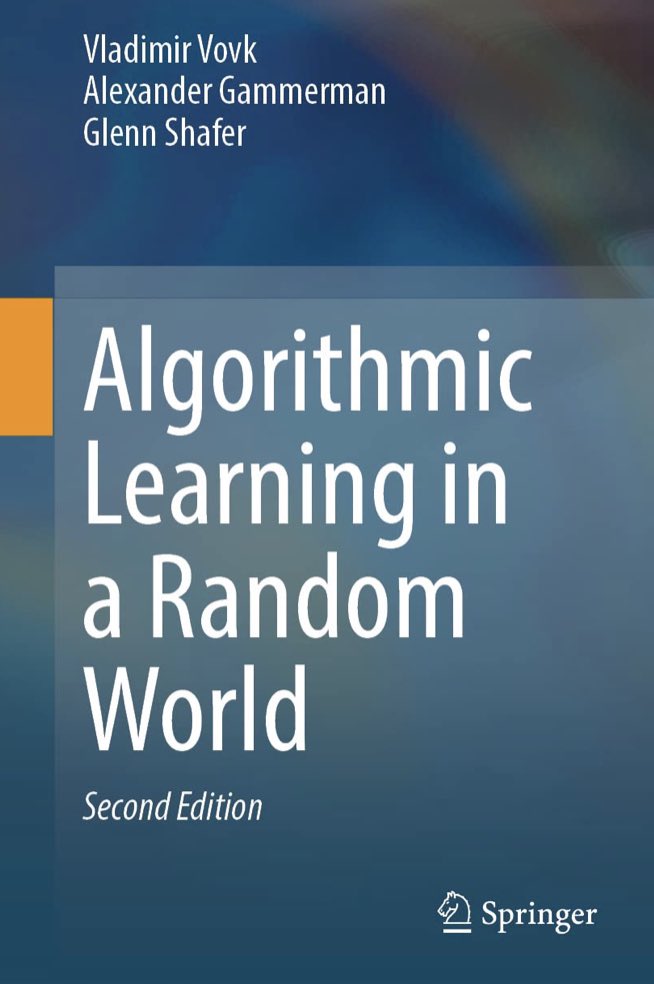 The main topic of this book is conformal prediction,
a method of prediction recently developed in machine learning.
Conformal predictors are among the most accurate methods of machine learning,
and unlike other state-of-the-art methods,
they provide information about their own accuracy and reliability.
The main topic of this book is conformal prediction,
a method of prediction recently developed in machine learning.
Conformal predictors are among the most accurate methods of machine learning,
and unlike other state-of-the-art methods,
they provide information about their own accuracy and reliability.